
 EN
EN
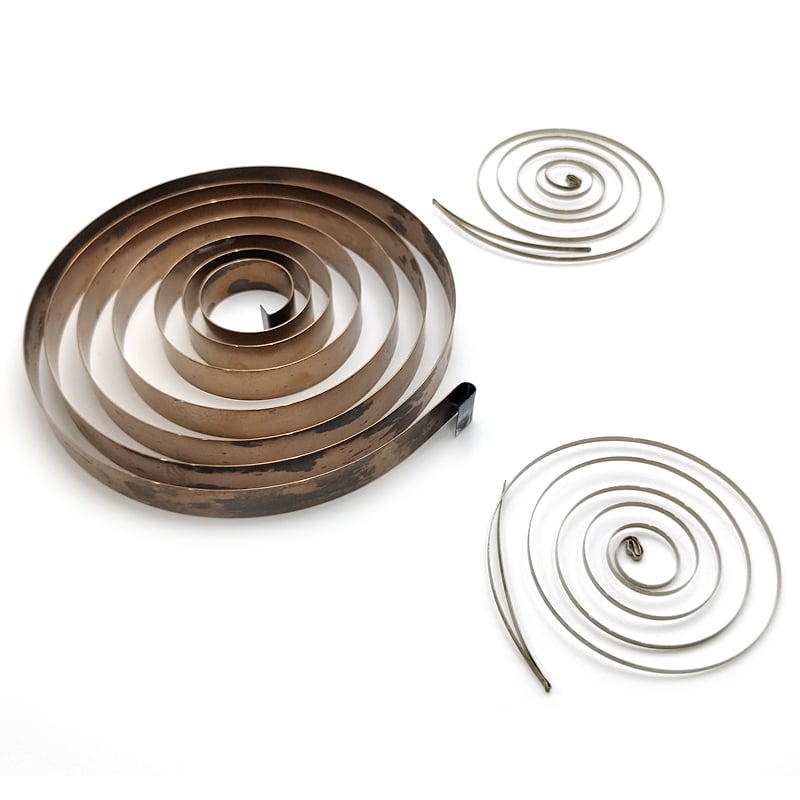
The spring performance is critical in the sphere of precision engineering and production. In any industry, whether automotive or aerospace, the medical devices industry, or electronic industry, a spring is not only a part, but it is an essential part of both functionality and reliability. Our company, Xiamen Hongsheng Hardware Spring Co., Ltd. deals with the design and manufacturing of high-precision spring coils that are produced according to the latest specifications. One of the key features of this design process is the correct calculation of the rate of spring. This blog will take you through the concepts and steps that are required to calculate the spring rate when it comes to high-precision.
Understanding Spring Rate and Its Importance
Spring constant or spring rate is a value that measures the rigidity of a spring. It is characterized by the force needed to compress or extend a spring by one unit of length. High precision applications cannot afford inaccurate and variable spring rate. It provides predictable performance, helps in ensuring stability of the system, and also ensures that the final product performs as planned throughout its lifecycle. An inaccurate rate of a spring can cause a failure of the product, intermittent functioning, or shorter life span and, this is the reason our development process at Hongsheng Hardware Spring Co., Ltd. is based on accurate calculation.
The Basic Formula and Its Variables
The fundamental equation used in the calculation of the spring rate (k) of either a helical compression or extension spring is obtained out of the theory of elasticity. The most common formula is k = (Gd⁴) / (8D³N), where G represents the shear modulus of the spring material, d is the wire diameter, D is the mean coil diameter, and N is the number of active coils. Although this formula gives a good theoretical basis, the application of the formula in the high-precision springs needs an extra layer of consideration. All the variables have to be held to the lowest level of precision at all times since the slightest changes in the diameter of wires or the distance between the coils may drastically affect the resultant spring rate and behaviour.
Key Factors Influencing Precision in Calculation
Going beyond the simple equation, it is important to note that a high-precision spring rate can be achieved by taking into consideration a number of practical considerations. The material of selection, as well as its shear modulus that precisely matches its working temperatures, is important. Moreover, the curvature correction and stress correction might be required further in springs whose mean diameter to wire diameter ratio is high. The ends treatment of the springs also has an impact on the number of active coils; e.g., the number of active coils is lower than that of the total number of springs in closed and ground ends. Empirical data and sophisticated software are applied in modeling these factors at Hongsheng Hardware spring and in addition to this our engineering department has ensured that whatever they calculate exactly translate to the real world performance of a certain type of system.
Leveraging Expertise for Optimal Spring Design
Finally, the calculation of the spring rate is a science and an art particularly in high-precision coils. It does not just demand mathematical accuracy but also requires a great amount of practical experience in manufacturing tolerances, material behavior and application needs. At this point, the experience of Xiamen Hongsheng Hardware Spring Co., Ltd. is priceless. Our years of experience in manufacturing coupled with modern technology will help us to steer our clients in the very first calculation stage until to the prototype development stage and even to the complete production. Through our collaboration, you will be able to access the team that will work hard to turn accurate calculations into dependable high-performance spring solutions that can be applied to your unique requirements. We will assist you in making sure all coils count.